
Price testing: how to try pricing ideas without setting fire to your business
I spend a lot of time with businesses helping them to improve their pricing. And one of the most common mistakes I see is companies making wholesale pricing changes without testing first.
You’ve done the analysis. You’ve got a strong hypothesis. You’ve even got a number you think is right.
But without testing, how will you know if the change is having an impact? And if it is, how big an impact? If sales volume drops, are you still better off because your margins have improved?
The thing is, testing isn't radical. It's sensible, because pricing is rarely uniform across your entire product range or customer base. Some customers are more price sensitive than others. Some products have more elasticity. Some channels can bear higher prices. Your pricing change might actually be damaging the business. Within your business, you might need evidence to persuade the board to accept your proposals.
And you won't know any of this unless you test. So let's talk about how to actually do it.
In my book How to Price Your Platypus, I describe two ‘prime methods’ of testing: A/B testing (run options simultaneously) and longitudinal testing (run options sequentially over time). Those two are the backbone - but they’re not the whole toolkit.
This article is a practical field guide to every price-testing method I’d consider using, and exactly how to run each one.
But first, before you test anything, try answering these three questions…
1) What are you trying to improve?
If the answer is ‘revenue’, you’re only halfway there. Revenue is easy to grow by discounting. The hard part is growing profit, cash, and long-term value.
A good test has:
One primary metric (e.g., contribution margin per visitor, profit per quote, gross margin per customer, LTV)
A few guardrails (e.g., refund rate, complaints, churn, conversion rate, NPS, support tickets) which, if you see these metrics going the wrong way, mean you need to modify or stop the test
2) What could go wrong, and what will you do if it does?
Write down your ‘kill rules’ in advance. Examples:
If conversion falls by more than X% for two consecutive weeks, stop.
If refunds rise above Y%, stop.
If customer complaints spike by Z%, stop.
3) How will you avoid annoying customers?
This is a bigger deal than many pricing teams admit. In my book, I explicitly warn that it’s one thing to run a controlled test, and another to charge different customers different prices over a longer period - because you can upset customers and damage trust.
So: decide where fairness matters most, and be deliberate in how you approach things.
Method 1: True A/B price testing (the gold standard)
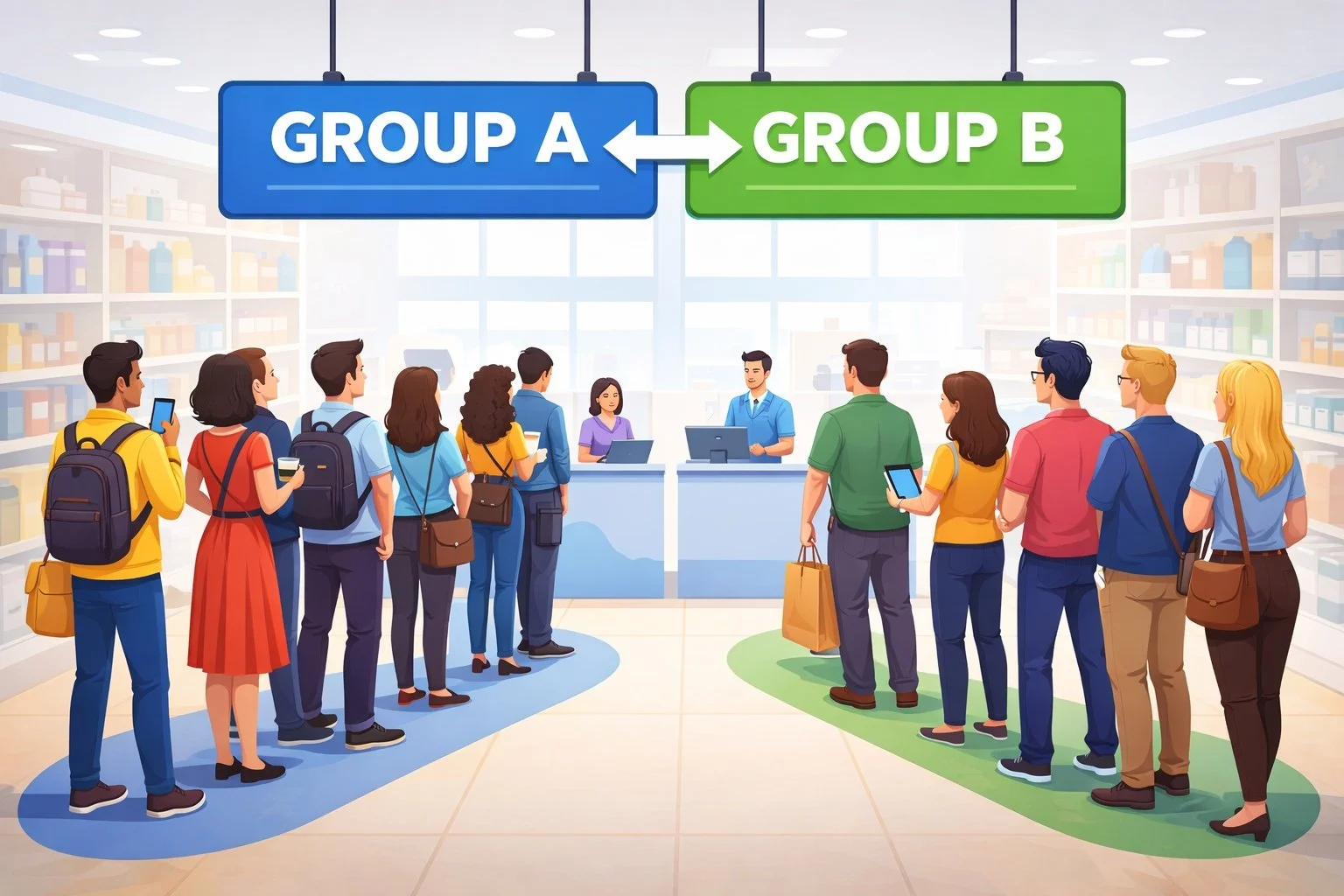
The concept is straightforward: you show one price to one group of customers (Group A) and a different price to another group (Group B), then compare the results.
How to run it:
Decide how you are going to split customers into group A (the test group) and group B (the control group). The best practice is to randomly assign customers.
Best: randomisation in your website/app/checkout.
If you can’t do that, use something non-behavioural, but be careful: any pattern that correlates with customer type can bias results. This could be using the customer’s first initial of the business name, and put A, C, E into group A; and B, D, F into group B. Or, if you generate sales order numbers, you could put all even sales numbers into group A, and all odd sales numbers into group B.
Consider other ways of splitting, such as geography. If, for example, you have 7 retail outlets, you could compare historical sales for all of them to identify ones that track over time, then split those that track into the two groups. Be careful – if you test all customers in Yorkshire vs all customers in London there is a good chance there will be confounding factors that will distort the results! I discuss this more below.
Run it long enough to smooth noise and be statistically significant.
At minimum, cover a full sales cycle (e.g., both weekdays + weekend), ideally 2–4 cycles if volume allows.
Use a website (Google: “statistical significance calculator”) to help you understand how many sales you need to have confidence (e.g., 95% confidence) that the results you are seeing are not chance; the website will ask various questions and give you advice.
Compare outcomes:
Don’t just look at conversion or revenue. Look at profit per sale, refund rates, churn, and downstream effects.
Practical tips:
Test one change at a time. If you change price and packaging and messaging, you’ll have no idea what caused the outcome.
Perform ‘hold price constant, change framing’ tests too (more on that below). They’re often higher-leverage and lower-risk.
Don’t stop the test too soon because of early promising results – complete the test when you have sufficient data to be confident of statistical significance.
Be very careful about customer interaction. If customers realise they are being charged different prices that can lead to a PR problem – plan ahead on your response.
Method 2: Multivariate and factorial tests (when you have lots of web traffic or very high sales volumes)
If you want to test multiple things at once, such as several price points and multiple packaging options, a factorial design helps.
Example:
Price: £49 / £59 / £69
Package: Basic / Pro
That’s 6 combinations!
How to run it:
Start with a screening test (shorter, broader) to eliminate losers.
Follow with a confirmation A/B on the top two.
Keep guardrails tight. These tests can create messy customer experiences if you’re not careful.
In other words, run this exactly like an A/B test, but with a short initial screening period to try to eliminate enough options to allow you to then do a simple A/B test.
Alternatively, you could decide to run the full test on all six combinations (groups A to F plus control group G). The principles are just the same as the A/B test, but you have to be very careful that there is no leakage between the groups (e.g., someone buys on one day and is allocated into group C, then buys again a day later and is in group E). You also have to ensure you get enough data to be sure any results are real.
Method 3: Longitudinal testing (when A/B isn’t practical)
Let’s say you have one coffee shop. You want to test something like price anchors on the menu. You can’t realistically charge different people in the same queue different prices, or swap the menu between A and B whenever anyone walks into the shop without causing chaos, so you split by time (e.g., alternating month 1, month 2, and running this for say 6 months).
How to run it:
Pick a stable period (avoid major holidays, product launches, stock issues).
Run baseline first (A).
Run the new price (B).
Repeat the sequence if possible to reduce seasonality effects.
Track the same metrics throughout.
Compare outcomes, especially total net margin.
Practical tips:
Test one change at a time. If you change price and packaging and messaging, you’ll have no idea what caused the outcome.
Watch-outs:
Seasonality, competitor activity, weather, channel mix… all can fool you.
If you need speed, shorten periods (e.g., weekly), but only if transaction volume is high enough to be meaningful.
Method 4: Geographic or “cluster” tests
These are very good for retail and field sales. Instead of randomising individuals, you randomise stores, regions, branches, sales teams, or customer territories. This was mentioned above as a potential method of A/B testing, but let’s explore in more detail.
How to run it:
Group locations into clusters that behave similarly (similar footfall, demographics, size).
Randomly assign clusters to A or B.
Run for a full trading cycle (often 4–12 weeks).
Compare results per store and the totals for each group; doing the per-store analysis might help to identify changes that some customers respond to but not others.
Again, use a significance calculator to see how many sales you need to be sure you are seeing a real effect.
Compare outcomes, especially total net margin.
Why it works:
It’s operationally simple.
It reduces the customer fairness issue, because people aren’t comparing notes as easily across regions.
Method 5: Stepped-wedge rollouts
This is the grown-up version of ‘pilot then roll out’.
You introduce the new pricing to a small group first, then gradually expand - but you do it in a structured way so you still learn.
How to run it:
Start with 5–10% of customers / transactions.
Calculate the number of customers / transactions to reach your desired level of confidence in the statistical significance.
Increase to 25%, then 50%, then 100% on a schedule. You can start the first step to 25% before you have reached a statistically significant level of confidence, because you are doing it a step at a time, and by widening the scope you accelerate the capture of data. But you only take the next step if the data looks like you are getting the results you want; if not carry on with the smaller group until you have enough data, and if it’s not working then stop.
Keep a holdout group on the old pricing for longer than you feel comfortable (that’s where the learning comes from).
Monitor guardrails at every step.
Method 6: Holdout testing (for subscriptions, churn, and renewals)
If you run subscriptions, the ‘moment of truth’ often isn’t the initial sale - it’s renewal, expansion, and retention.
How to run it:
Keep a randomly selected group on current renewal pricing (the control).
Offer the new renewal pricing to everyone else (the treatment).
Track:
Renewal rate
Downgrades
Expansion
Support contacts
Complaints
Net revenue retention
Net profit
This is also excellent for testing discount policies (e.g., ‘15% off if you renew early’ vs ‘no discount but added value’).
Method 7: Sales-led pricing tests (B2B quote experiments)
A lot of B2B firms can’t A/B test because sales volumes are low, sales are quotation led and each quote is unique, and the price is quoted by humans.
You can still test - you just test in the workflow.
Simple, practical approaches…
A) Quote band testing
Pick two fee levels (A and B).
Assign opportunities randomly (e.g., by week number, by salesperson rotation, by CRM rule).
Track win rate and margin.
B) Good / Better / Best testing
Always propose 3 options.
Keep the middle option as your target.
Test the price gaps and feature fences.
C) Concession strategy testing
Don’t just test the headline price.
Test how negotiation works:
“No discount, but add value”
“Discount only for longer term”
“Discount only for upfront payment”
Track: win rate, discount depth, payment terms, future expansions.
Method 8: Message and framing tests (often more powerful than price changes)
Sometimes you don’t need a new price. You need a new reason.
You can test:
Monthly vs annual framing
‘From £x’ vs ‘Typical customer pays £y’
Anchors (show premium first)
‘Free’ inclusions (not core product) - which can lift conversion without lowering price.
Run these exactly like A/B tests, but keep the underlying price constant.
Method 9: Pilot programs and beta testing
This approach works particularly well for new products, new markets, or major pricing model changes.
How to run it:
· Recruit pilot customers. Find customers willing to try your new pricing model. These might be loyal customers, early adopters, or those in the target segment for the new approach.
· Set expectations. Be clear that this is a pilot and that pricing may change. Good customers will appreciate being part of the development process.
· Offer something in return. Pilot customers might get discounted pricing, extended terms, or early access to new features. They're taking a risk with you, so acknowledge that.
· Gather extensive feedback. Don't just track numbers - have regular conversations with pilot customers about how the pricing works for them. What's confusing? What's working well? What would they change?
· Iterate quickly. The beauty of pilot programs is you can make changes rapidly based on feedback. Use this flexibility to refine your approach before broader rollout.
One big warning: don’t accidentally run a “fake sale”
If your test looks like a promotion – ‘was £x, now £y’ - you’re now in a different world: advertising rules and consumer protection.
At a minimum, your reference pricing must be genuine and not misleading. The ASA has detailed guidance on promotional savings claims and reference prices. If you’re selling to UK consumers, you also need to understand the broader rules around price indications (e.g., displaying selling price clearly, unit pricing expectations, etc.).
Also: the old ‘28-day rule’ is widely talked about, but UK guidance has shifted over time towards a more contextual assessment rather than a simple safe-harbour rule - so be careful about assuming a single magic number of days at a higher price applies in every case.
If your test is a pricing experiment, keep it framed as a pricing experiment - not a discount claim.
How to decide if the test worked (a sanity check)
A price increase doesn’t have to maintain sales volume to be a success.
In the book, I show how you can afford to lose a surprising amount of volume and still make the same profit - because extra price mostly drops straight to the bottom line.
So when you evaluate results:
Convert everything to profit (or contribution), not just conversion.
Ask: ‘If we rolled this out fully, what’s the expected impact on profit, cash, and customer sentiment?’
The point of testing isn’t caution - it’s confidence
Good pricing isn’t ‘pick a number and hope’.
It’s: have a hypothesis, run a controlled test, learn quickly, and roll out deliberately.
If you want to receive these monthly blogs direct to your inbox then subscribe to my monthly pricing bulletin – simply send me an email from the email account you want the bulletins to go to with a subject line ‘SUBSCRIBE’.