
Most Firms Use Five Pricing Tactics - Here Are Fifty

Actually, I told a fib. There aren’t fifty. There are sixty-five, but I love a bit of alliteration.
The majority of pricing activity within a firm is tactical – short term pricing actions to achieve short term goals. But almost everything written about pricing focuses on pricing strategy.
Ok, that’s fair, you’ve got to have clear pricing objectives and pricing strategies as a foundation.
But what about those tactical pricing decisions?
There is a process to pricing. It starts with the initial analysis – what value is being delivered, how does that compare to competitors, what are the customer’s/client’s real needs, etc. That flows into decisions on pricing objectives, pricing strategy, and ultimately the price you want to charge.
Once you have decided on your strategic price, that’s when the tactical side to pricing becomes relevant. Pricing tactics are usually designed to incentivise an action (such as increase sales volume) and are normally short-term.
I’m going to list the typical tactical aspects of pricing, but before I do there are some things to be aware of.
First, the margin maths. A discount has to be bought back with disproportionate volume, and most people badly underestimate by how much. At a 10% net margin, a 5% discount needs roughly a doubling in volume just to stand still (the exact target depends on the ration of fixed to variable costs). If the extra volume doesn't come, you've simply given money away. Always calculate your real break-even, based on net margin rather than gross margin, and be clear about your objectives.
Second, where possible, test your promotion on a small sample to be sure it is both driving the right behaviour, and is doing so enough to achieve your targets.
Third, you need to think about what you are communicating to your customers and clients. What are you training them to expect? If you regularly have promotional prices of some kind, eventually they will start to wait for the next promotion.
For example, I have mentioned before that I really like chocolate. My favourite chocolate biscuits are Fox’s Chocolatey Rounds. They’re normally £2.50, but often get discounted down to something like £1.75. The promotion seems to run on a 6-week on / 6-week off schedule. So if they are at full price I just wait for them to be on promotion, then buy more of them! I can afford the full price, but I’ve been trained to wait for the expected discount.
What’s happened is cannibalisation of existing sales (i.e. forward buying). My total volume of purchases each year hasn’t changed, what’s altered is my pattern of buying to get the discounted price. Because this is a regular discount rather than a one-off, it is no longer impacting overall volume.
Fourth, you have to think about your position in the market. Assuming that your normal price reflects your brand, discounting can alter its perception. Perhaps your product or service stands for quality; a lower price usually signals lower quality. If you are adjusting your prices, you should think about clearly communicating why, how long the new price will last, and what the normal price would be.
Fifth, what is the impact on your internal teams? Let’s say you sell products in a B2B market (but this applies any time your team makes direct sales and has authority to vary prices). You have a premium brand position. If they regularly discount to achieve a short-term goal, that becomes their standard approach. Before you know it, your regular prices are all lower on average than you had planned.
Sixth, legality and presentation. UK rules tightened materially in 2025. Since 6 April 2025 the Digital Markets, Competition and Consumers Act 2024 has reshaped how businesses must present prices and promotions to consumers, with the CMA able to impose fines of up to 10% of global turnover. In practice this means three things for anyone running promotions: "was/now" pricing must be genuine – the "was" price should have been a real selling price for a reasonable period beforehand; drip pricing is now banned, so all mandatory fees must be in the headline price, not added at checkout; and misleading countdown timers are caught too.
Loyalty-scheme pricing is also treated as a form of reference pricing, so a loyalty-versus-standard price comparison has to reflect a genuine advantage. Given the CMA opened its first enforcement cases under the new regime in November 2025, this is a live risk, not a theoretical one.
Finally, seventh, an exit plan. Before you discount, decide how you climb back to full price. Promotions are easy to start and hard to stop – the chocolate-biscuit problem in reverse.
What follows is a list of potential tactical pricing ideas for you to consider. I don’t expect anyone to read this list – think of this as a menu to keep for the next time you are thinking about short-term pricing challenges, such as stimulating sales.
1. Discounting Tactics
Use these when the lever you want to pull is price itself – you need to move volume, shift stock, or win and keep a customer, and you're willing to sacrifice margin to do it. These are the most frequently used tactics, and the easiest to overuse.
Promotional Discount (including Seasonal Discount)
Temporary price reduction for a specific period.
Coupon/Voucher/Promo-Code Discount
Offer which the customer has to redeem.
Cashback
Money returned after the purchase (also needs customer action).
Clearance Discount
Reduce prices to sell excess, slow moving or obsolete stock.
Volume Discount & Bulk Purchase Discount
Lower unit price when customers buy larger quantities.
Loyalty Discount
Reward repeat customers with lower prices.
Win-Back Discount
Offer incentives to former customers to return.
New Customer Discount
Reduced price to encourage trial.
Trade-In/Trade-Up Allowance
Credit for an old product against a new one.
Employee Discount
Reduced pricing for staff.
Partner Discount
Special pricing for distributors, affiliates or strategic partners.
Early Payment Discount
Reduced price for prompt payment, offered up front.
Cash Discount
Lower price for cash or lower-cost payment methods, e.g. avoiding card payment costs.
Settlement Discount
Reduction offered to settle outstanding debts, a one-off incentive to bring in cash.
Negotiated Discount
Case-by-case reduction during sales negotiations.
Rebate
Retrospective discount based on sales volume achieved over a period.
Loss Leaders
Sell selected items below cost to drive footfall or basket size, profiting on everything else the customer buys.
Recommend-A-Friend
Both the existing and the new customer get a reward.
2. Multi-Buy Promotions
Use these tactics when the goal is to get each customer to take more in a single purchase, rather than to lower your headline price (though this still has a margin impact, of course). Good for increasing basket size and shifting volume without visibly cutting the list price of a single unit.
Buy One Get One Free (BOGOF)
Receive an additional item free.
Buy One Get One Half Price
Second item at a reduced rate.
Buy Two Get One Free (3 for 2)
Common in FMCG and retail.
Mix-And-Match
Any 3 for £x across a range.
Multi-Pack Pricing
Several items sold together at a lower effective unit cost (particularly if you receive the goods in a multi-pack format and this avoids handling costs involved in breaking them down to individual units).
Bundle Pricing
Different products sold together at a combined price.
Family Pack Pricing
Larger pack size with lower unit cost; note, each pack is larger, it is not multiple packs bound together.
Meal Deal Pricing
Several complementary products bundled together.
3. Quantity & Threshold Tactics
These are useful when a customer is close to making a purchase and a small reward will push them over. You're offering an incentive to change the size or shape of the order, not the headline price.
Spend £X Get £Y Off
Discount triggered once a spending threshold is reached.
Free Delivery Threshold
Free shipping above a minimum spend.
Tiered Pricing
Prices change at defined quantity breaks.
Stair-Step Discounts
Increasing discounts as volume increases, which are applied retrospectively to previous purchases once the customer. Moves to a higher volume.
Consumption-Based Pricing
Price depends on actual usage, such as per seat, per transaction, per license.
Minimum Order Value
Price benefit only applies above a certain order size.
4. Time-Based Tactics
Appropriate if the problem is when people buy, not whether they buy. These smooth demand or improve cashflow – pulling sales forward, pushing sales into quiet periods, or capturing more sales when demand peaks.
Early Bird Pricing
Lower prices before launch or event.
Advance Purchase Pricing
Cheaper if booked ahead.
Last-Minute Pricing
Discount excess inventory near expiry.
Flash Sales
Very short-term discounts.
Happy Hour Pricing
Time-specific discounts.
Peak Pricing
Higher prices during busy periods (longer-term than surge pricing).
Off-Peak Pricing
Reduced prices during quiet periods.
5. Subscription & Recurring Revenue Tactics
Use when the value is in the length of the relationship, not the single sale. The objective here is to lower the customer acquisition barrier and then reward customers for staying.
Freemium
Basic version free; premium features paid.
Free Trial
Temporary free access.
Introductory Pricing
Discounted first period.
Founder Pricing
Special pricing for early adopters.
Loyalty Pricing
Reward long-term subscribers.
Price-Lock/Grandfathering
Existing customers keep their old rate when you introduce a new one.
Multi-Year Pricing
Reduced rates for longer commitments.
Auto-Renew Discount
Benefit for continuous renewal.
6. Payment Structure Tactics
These work when price isn't the obstacle – affordability is. The customer wants what you're selling, but the upfront cost or the cash-flow hit is the thing stopping them. You change how they pay, not what they pay.
Instalment Pricing
Spread payments over time.
Financing
Third-party credit arrangement.
Deposit Pricing
Partial upfront payment.
Deferred Payment
Pay later.
7. Free-Based Tactics
Use when you want to add value rather than cut price – protecting your headline number while still improving the offer. These are the right options to consider when a discount would damage your positioning but you still need to give the customer a reason to act.
Free Delivery
No shipping charge.
Free Setup
No implementation fee.
Free Training
Included onboarding.
Free Support
Ongoing support included.
Free Upgrade
Future enhancements included.
Free Warranty
Extended protection included.
Free Audit
Diagnostic service included.
Free Consultation
Initial advice at no charge.
8. Advanced B2B Tactics
These work well when deals are large, bespoke and/or negotiated, and the buyer's real concern is risk and outcome rather than unit price. These align what you charge with the value you deliver, and take risk off the table to get a deal over the line.
Gain-Sharing
Supplier shares financial benefits achieved, e.g. when solar panels are fitted the supplier takes a share of the savings.
Risk-Reversal Pricing
Supplier absorbs part of the risk, e.g. a money-back guarantee that moves the risk from the buyer to the seller.
Success Fee Pricing
Payment only upon achieving results, e.g. recruitment head-hunter only paid on successful placement.
Price Fences
Rules or conditions that separate customers into groups so you can charge each a different price without the cheaper price leaking to everyone.
Price-Match / Most-Favoured-Customer Guarantee
A promise the buyer will always get your best available price.
Growth/Tiered Rebate
A rebate that scales with year-on-year growth, not just absolute volume.
Putting these into practice…
You should always start with a clear objective. What is it that you want tactical pricing to help you achieve? Once you are clear about the goals, the table below helps suggest some options from the list of pricing tactics above.
Whatever you decide to do, though, I cannot emphasise enough the importance of doing the maths to make sure your tactics don’t have an adverse impact on net profit.
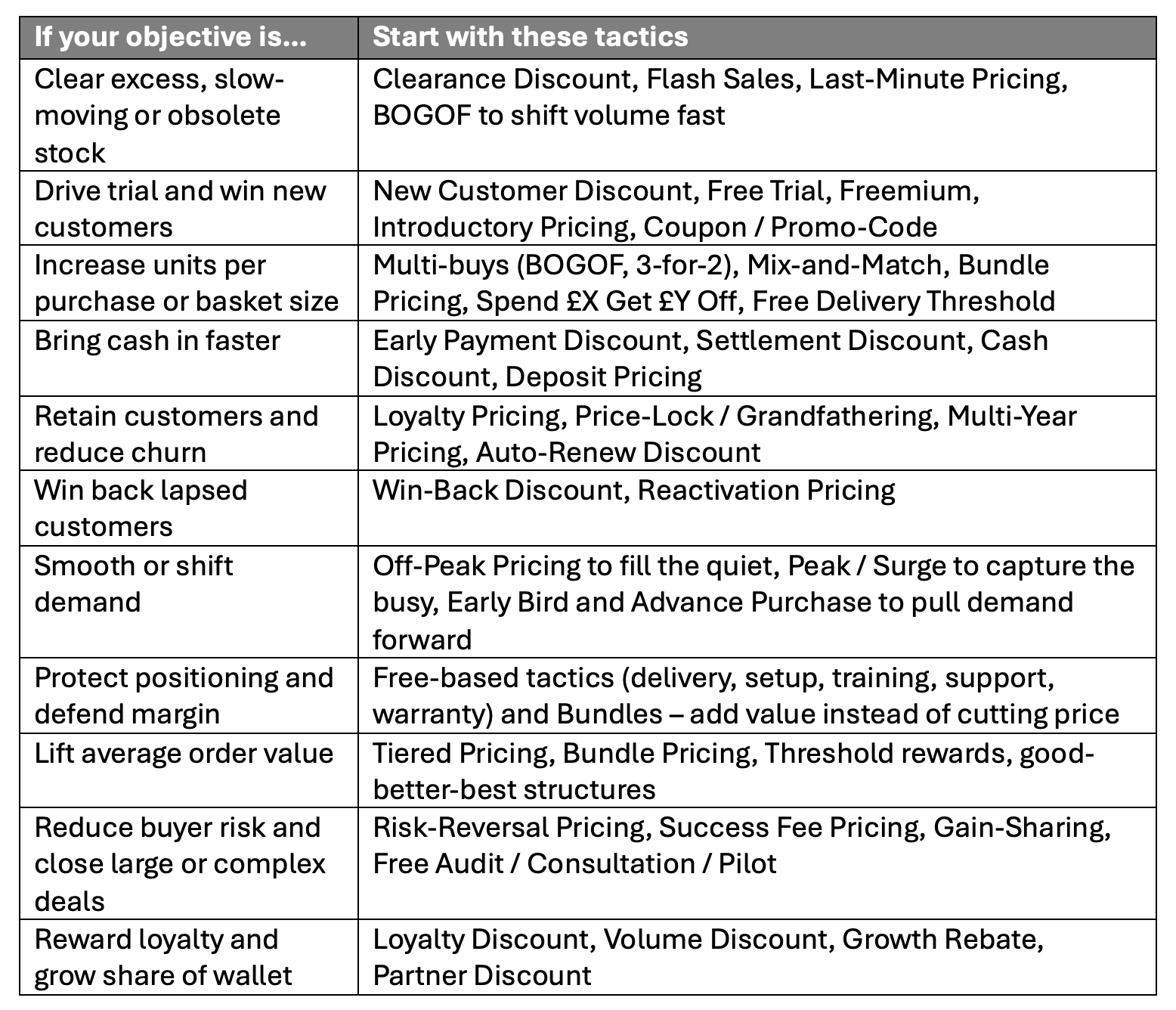
There are a lot of tactical pricing options to choose from. Most organisations are only aware of, or only think about, a small fraction of the full list – usually promotional discounts, clearance discounts, multi-buys such as buy-one-get-one-free, and some sort of volume discount such as spend £x get £y off. But depending on your objectives, there are many different approaches you can consider to achieve your goals.
If you want to receive these monthly blogs direct to your inbox then subscribe to my monthly pricing bulletin – simply send me an email from the email account you want the bulletins to go to with a subject line ‘SUBSCRIBE’.