
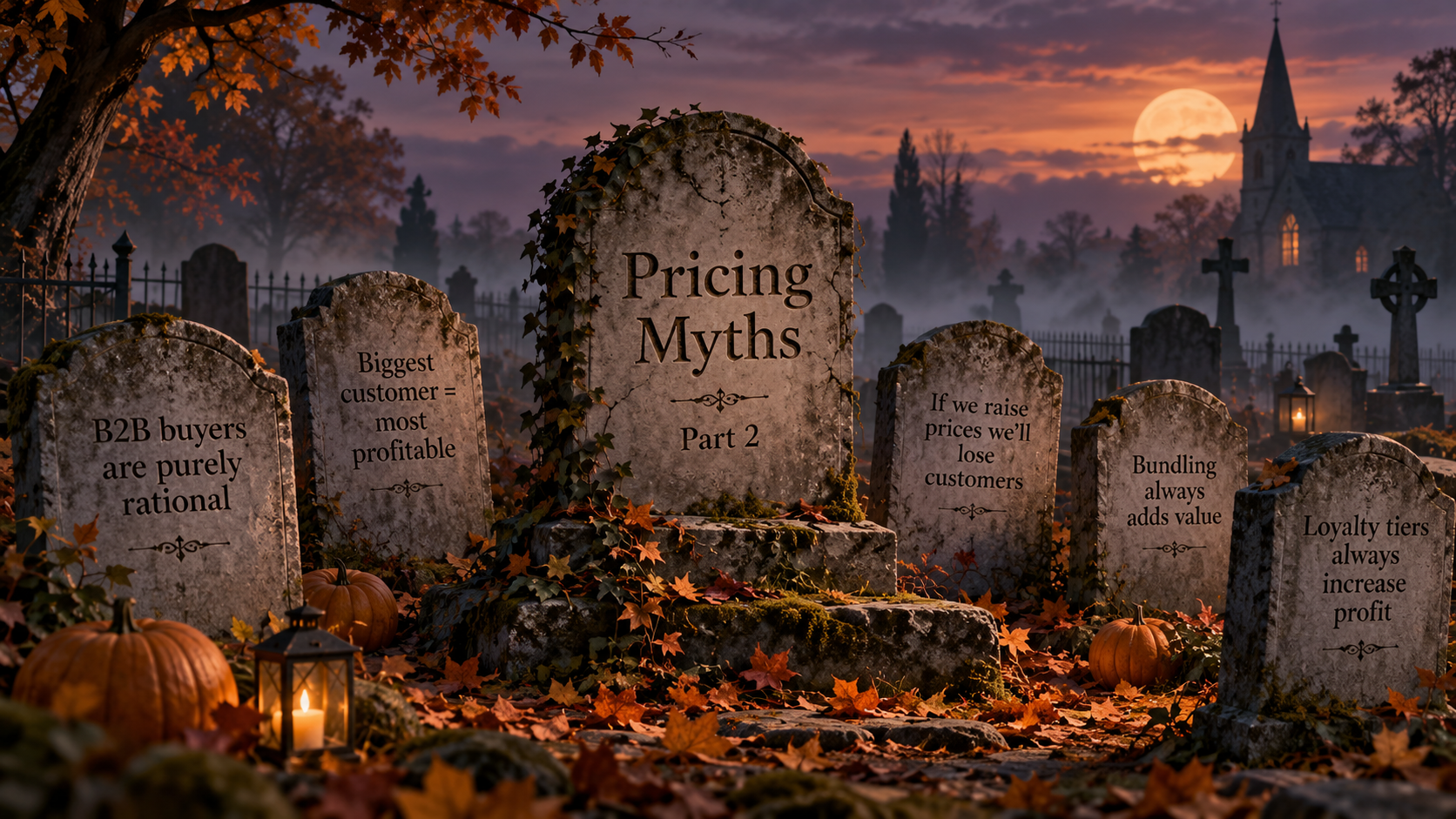
Last month I talked about some of the common myths about pricing. The eagle-eyed among you will have noticed that I had a list at the top of the piece which broke those myths down into universal myths (things like ‘customers only buy on price’ and ‘discounting wins volume’), and myths that apply to B2B markets and B2C markets – but I only covered the universal ones.
Let’s face it, it was a chunky item having only covered the first half!
So this month I’m going to return to pricing myths and will cover the B2B and B2C items.
Buckle up!
B2B myths
1. B2B buyers are purely rational, and only look at the facts in front of them
Doesn’t this make life simpler? You only need to focus on spreadsheets, specs, bidding portals and ROI calculations. If the buyer is purely rational, it’s just down to the numbers.
However, the evidence suggests that even in B2B purchases, non-rational factors come into play.
One of the examples I often quote is RBS (Royal Bank of Scotland), which bought ABN Amro Bank in 2017. Most analysts considered that they over-paid for the acquisition, and certainly it meant that they were massively over-leveraged. When, in 2018, the financial crisis struck, their wholesale funding dried up leading to a run on the bank. It was taken into public ownership.
But by buying ABN Amro they became the biggest bank in the world. Their CEO, Fred Goodwin, became the CEO of the biggest bank in the world. Their board, meant to apply checks and balances, were part of the biggest bank in the world. They overpaid because it became an emotional objective.
If it can happen at that scale, it can happen anywhere in business. Yes, it's true that B2B is more analytical, in general, than B2C. But humans are still involved.
Another example: most FTSE 100 or S&P 100 companies use the world's largest auditors – firms like Deloitte, EY, KPMG and PwC. They could save money and get at least the same level of expertise and service by going down one tier, but they like the brand association of having world-famous auditors working with them.
As well boards like RBS being driven by emotion, the individual or individuals making the decision within most businesses are too. Does this make them look good? Save them effort and make their lives easier? Get them a bigger bonus? Reduce the risk of them being blamed if something goes wrong? There's a reason for the old saying that “nobody ever got fired for buying IBM”.
The mitigation, in this case, is to understand both financial and non-financial reasons for the company's decision, and the personal factors – again, both financial and non-financial – relevant to the decision maker.
2. Dynamic pricing is only for airlines, hotels and Uber
It's true that only some industries have the volume of data, and can afford the computing power, to do real-time dynamic pricing. But most industries can operate a manual form of dynamic pricing, by regularly checking a key metric such as utilisation, and then use a simple algorithm to decide on the price.
In B2B, that key metric might be the run rate on a production line, spare delivery capacity on a particular route, how full a training course is a few weeks out, or the length of the order book. A simple rule such as ‘if lead times are under three weeks, quote the standard price; if they're over six weeks, add a premium for priority delivery’ is a form of dynamic pricing.
In this context, 'regularly' might mean weekly, or even daily. It's important that customers understand prices can vary, and the rationale behind it. As an example, the rationale might be that prices are not higher during high demand – they are lower during low demand, to stimulate sales.
How to mitigate? Identify the one or two metrics that best reflect demand against capacity, set simple rules for how price responds to them, and review those rules regularly.
3. Sales reps know exactly what the client will accept as a price
This certainly empowers the sales team, gives them flexibility, and helps to shorten the selling cycle by avoiding the need to refer back to head office to agree a price.
Sadly, however, this myth this is seldom true. Not because salespeople are unintelligent or don't understand the customer, but because the information they are given by the customer is highly filtered or curated. When a potential customer decides to use a different supplier, rather than get into an argument over details they will often say "we had a cheaper quote".
When the salesperson repeatedly hears the message 'we bought from a cheaper alternative', what they absorb is 'if only our prices were lower, we could sell twice as much'.
Mitigation: often the challenge is that the organisation has not put the effort into clearly establishing the value the customer receives, and equipping the sales team with the tools to communicate that value. It also helps to capture win/loss reasons more rigorously, ideally through someone other than the sales person, as customers are often more candid with a neutral third party. Set clear limits on discount authority, so that price is only conceded in exchange for something of value in return. And consider how you are motivating the sales team – what is their bonus structure?
4. Our biggest customers are our most profitable
Our biggest customers also get the best discounts, rebates, service enhancements (which carry extra costs), and so on.
It is entirely possible for your biggest customer to make zero or negative net profit.
I knew a Marketing Director for a furnishings manufacturer. Their biggest client was very demanding, and expected the best prices plus rebates plus many other things that degraded margin. When he analysed the customer, he found they made no money at all with them. He and the Sales Director visited the company and explained the situation, also explaining that prices had to go up. The customer decided to move all their business elsewhere. Sales dropped to zero.
But the two directors were brave and stuck to their guns. Within months the customer was again spending about 80% of what they had previously spent, because they couldn't get the same products or level of service elsewhere – and those sales were now profitable.
So the mitigation is to use a relevant analysis, such as a cost-to-serve analysis, a Simplified Activity Based Costing analysis, or a Recency, Frequency and Monetary Value analysis, to understand the different customer groups or customer behaviours. Then apply different prices to different groups related to the cost to serve, as well as considering other things, such as different service levels or the use of different channels.
5. If we increase our prices we'll lose too many customers
One of the most persistent myths, and usually one of the least correct.
For a start, it assumes a traditional demand curve where, as prices increase, demand falls. Often that is not the case. In B2B, demand is often stable with changing price until a threshold is reached, after which demand falls off. Sometimes the curve is more bell-shaped, where demand drops off at low prices as well, because the product or service is not seen as credible or reliable.
Increasing prices is actually inevitable. No organisation can absorb cost increases forever. Those that avoid what feels like a hard discussion with their customers, because they think they should 'let sleeping dogs lie' (i.e. not prompt a client to do a price comparison wit competitors), only face a much bigger and more challenging conversation in the future.
To mitigate this you need to understand where your price thresholds are – through win/loss data, customer research, or by testing an increase on one segment first – and to plan increases rather than avoid them. Smaller, regular increases with a clear rationale are usually far easier for customers to accept than a large, infrequent catch-up increases.
Or just be brave! The reaction to a price increase is seldom as bad as you think it be.
6. A high win-rate means we're priced about right
Well, it certainly motivates the sales team and helps create a perception that the product or service is pitched about right for the market.
However, it almost certainly means that products or services are underpriced. Margin is being left on the table. The organisation is probably operating at maximum capacity, but isn't generating the profit and cash flow it is capable of. It’s important for companies to analyse their volumes and model different levels of sales, with costs varying appropriately, to determine what the optimum volumes are.
Mitigation: establish an optimum win-rate, which might typically be anywhere from 30% to 70% depending on the business, the market, the concentration of competitors, etc. Then measure conversions, and increase prices whenever the conversion rate increases beyond the optimum.
B2C myths
1. Changing prices too often will alienate customers
This depends on the reasons for change.
If the economy is volatile, if supply costs are frequently changing, and if these factors are being clearly communicated, then most customers understand the need to vary prices. It is only when changing prices on a whim that a problem arises.
So mitigation is always having a clear reason, which is communicated directly to customers or, if that is not practical (e.g. in physical retail rather than eCommerce), through general communications in the press, on social media, etc.
2. Bundling extras always increases a customer's willingness to pay
The idea is that if the customer wants a certain package of products or services, offering more always looks like more value and increases conversions.
This is not always the case.
A researcher called Christopher K. Hsee asked customers the value of a dinner service (i.e. a set of plates, side plates, soup bowls, cups and saucers). They then asked different customers what they would pay for the same dinner service but with some additional items included, a few of which were seconds (i.e. were slightly flawed, perhaps having a small blemish in the glazing). In theory they should have valued the second option more – you get the full dinner service plus some free extra pieces, which could usefully replace an item that gets broken. But no – the presence of lower-value items in a higher-value solution, even though the lower-value items were free, reduced the perceived value of the total set.
This was reported in 1998 in the Journal of Behavioral Decision Making - Less is Better: When Low-Value Options are Valued More Highly than High-Value Options.
The lesson is that customers often judge a bundle by the average quality of what's in it, not the total. Adding something of lower value can drag down the perceived value of the whole.
So in mitigation only bundle items that match or enhance the perceived quality of the core offer, and test whether an add-on genuinely increases willingness to pay before including it. Sometimes less really is more.
3. Loyalty tiers always increase margins and retention
Loyalty systems can be powerful and very useful. Depending on the specifics, they can help capture more customer data, they can improve initial engagement, and they can create the feeling of belonging to an in-group.
However, they usually involve some sort of incentive for each tier, and incentives have costs attached, so the business is potentially reducing the profitability of its most frequent buyers. If margins are maintained by increasing prices for customers who aren't loyalty members, then the business might lose those that are particularly sensitive to price.
The best mitigation is to try to focus different tier awards on experiential (i.e. non-monetary) perks, which could include early access to new products or services, exclusive products or services per tier, priority phone numbers, etc.
Final thoughts
The message is very much the same as last month. The clearer you are about the value you are delivering, the more clearly you communicate it, the more you help your team to understand and communicate it when in front of a client, the more likely you are to avoid the myths.
If you want to receive these monthly blogs direct to your inbox then subscribe to my monthly pricing bulletin – simply send me an email (david@davidabbottspeaker.com) from the email account you want the bulletins to go to with a subject line ‘SUBSCRIBE’.